


What is a cash-in-transit account? #
A cash transit account is a special interim account used to record the movement of funds between different accounts within the same entity. It is used to ensure that all transactions are traceable and that no ambiguities arise, particularly when funds are transferred internally (transfer).
What is the account number for a cash-in-transit account in SKR03? #
In the SKR03 chart of accounts, the cash transit account has the account number 1360. However, this may vary depending on your individual account structure. Please check this in your chart of accounts.
Why should I use a cash-in-transit account? #
A cash transit account helps keep transactions clear and transparent. Without such an account, direct transfers between accounts could be difficult to track, especially if the funds are not credited to the destination account immediately. The advantages are:
- Traceability: Every financial transaction is documented.
- Minimizing errors: This prevents funds from “disappearing” or being processed incorrectly as a transaction.
- Simpler reconciliation: Using a cash transit account makes it easier to verify transactions.
What should I keep in mind when using it? #
- Time Frame: Make sure that deposits and withdrawals are posted to the cash transit account in a timely manner to avoid outstanding balances.
- Accuracy of the amounts: Verify that the amounts posted to both accounts match.
- No outstanding balances: The cash transit account should always be at zero once the funds have been completed.
- Clear Descriptions: Use clear and understandable descriptions in the transaction notes, such as “Transfer from Account X to Account Y.”
Example Bookings #
Example 1: Transfer from Account 1 to Account 2 #
- Opening entry for Account 1 (Congregation Bank):
- Credit: 1360 Cash-in-Transit Account
- Have: 1220 Bank Congregation
- Amount: 500.00 EUR
- Posting text: “Transfer to Fixed-Term Deposit Account 1”
- Credit entry to Account 2 (Fixed-Term Deposit Account 1):
- Target: 1,250 Fixed-Term Deposit Account 1
- Have: 1360 Geldtransit account
- Amount: 500.00 EUR
- Posting text: “Reclassification from Congregation Bank”
After these two bookings, the Geldtransit account should be balanced again.
Example 2: Open Transfer at the End of the Month #
- Opening entry for Account 1 (Municipal Bank) (end of the month):
- Credit: 1360 Cash-in-Transit Account
- Have: 1220 Bank Congregation
- Amount: 1,000.00 EUR
- Posting text: “Transfer to Fixed-Term Deposit Account 1” (open)
- Credit entry to Account 2 (Fixed-Term Deposit Account 1) (following month):
- Target: 1,250 Fixed-Term Deposit Account 1
- Have: 1360 Geldtransit account
- Amount: 1,000.00 EUR
- Posting text: “Reclassification from Congregation Bank”
This approach ensures that the cash flow remains clearly documented despite any delays.
Use rule-based suggestions #
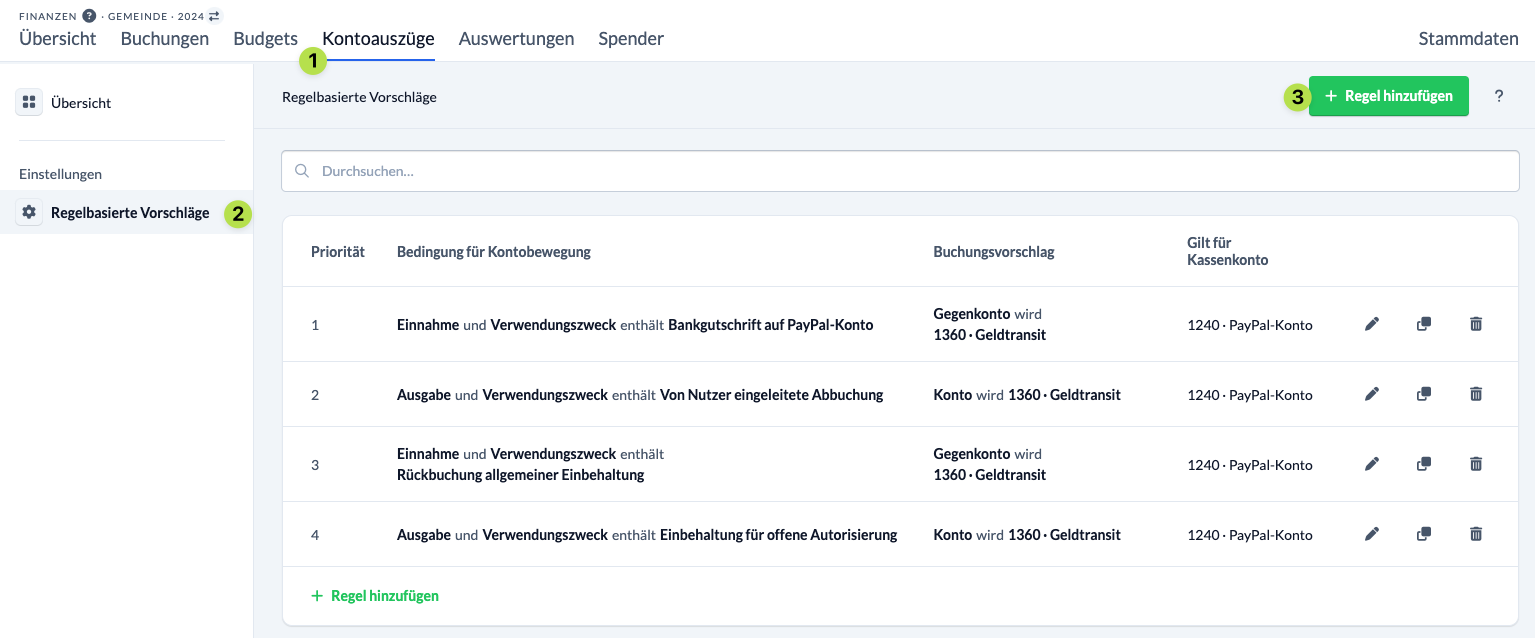
If you import transactions using bank statements, it’s a good idea to create your own rule-based suggestions specifically for this use case. For PayPal, this might look like this:
Rules are created to check the payment description for, for example, “Bank credit to PayPal account.” If the rule applies, ChurchTools will automatically suggest the Geldtransit account.
Summary #
A cash transit account is a helpful tool for accurately and transparently tracking internal transfers. Be sure to use it consistently and properly to keep your accounting clean and traceable.